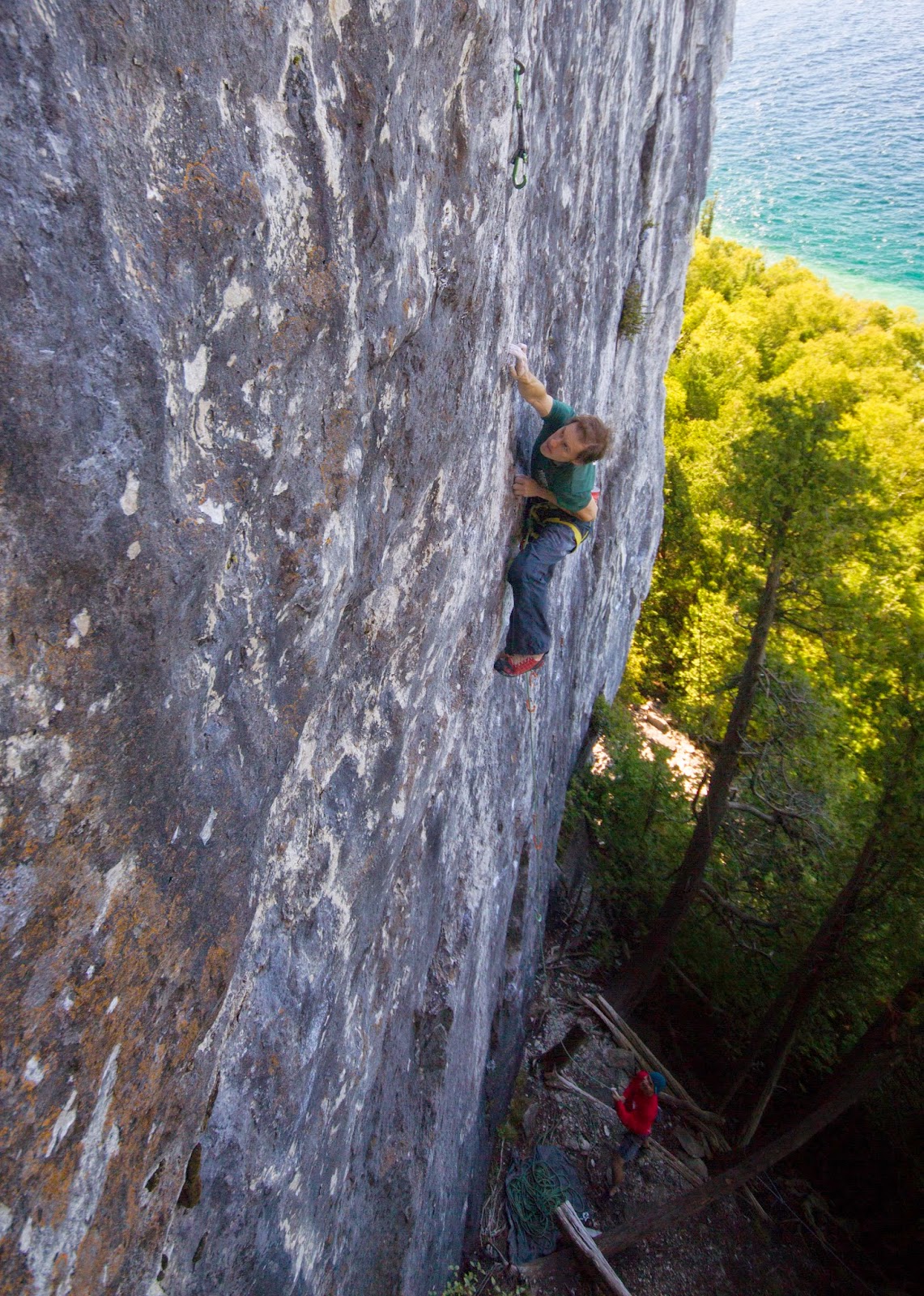
Friday, February 15, 2013

Coal Train

Back when I used to be a climbing guide, I had an impactful and memorable encounter with a woman I'd taken out for a full day trip at Endless Wall. I always enjoyed those rare one-on-one days with a reasonably fit person because I could take them away from the roadside top-rope crags of Bridge Buttress or Junkyard. I felt like the Endless Wall experience was more valuable for them due to the remote location and superior quality of the lines.

We roped up beneath some classic and I was excited for the lead/free solo since you can never trust their belay. I said something like, "You're going to love this route. It's a four star classic." The response I got still sticks with me. "What makes a route good?" she asked. I stood there a bit taken aback and honestly unable to answer the question on the fly. What makes a movie better than other movies? What makes a particular meal better than other meals? There are characteristics to routes that we all agree make them 'better' or 'worse' but, like a food preference, there are also feelings and sensations that accompany certain climbs that are hard to define. You could argue that vanilla ice cream is better than chocolate, or vice versa, and never be right.

I finished my Beauty Mountain project yesterday and my opinion is that it's the best route at the New and the best climb I've ever been on in my life. I'll go on to attempt a defense of that statement, but first a little history of Beauty Mountain.
Why is Beauty Mountain not part of Endless Wall? The answer is this little devil right here: Short Creek. One of the most beautiful streams in the region tumbles through the cliffline cleaving off the last mile of Endless Wall. That last mile is Beauty Mountain. Hiking down short creek is like a step into a magic forest with boulders, ferns, moss, and falling water everywhere.

Beauty is my favorite crag at the New. The quality and concentration of routes is unparalleled, even compared to Endless Wall in my opinion. Furthermore, the history of Beauty is a microcosmic display of overall New River history. You can look at just Beauty alone and get a feel of the progression of New River climbing. While some of the very earliest ascents were being done at Bridge and Junkyard, Beauty also saw late 70's action. In the early days, access was from the upstream end, and the core group of pioneers, including Bruce Burgin and Nick Brash were top-roping in the boulder field upstream of the descent gully. In 1979, the duo descended to the cliff base for the first ascent of Screamer Crack, a wide 5.8 on the Thunder Buttress, and a year later for Supercrack, the New's best traditional pitch of 5.9.  Steve Erskine, Hobart Parks, and T.A. Horton climbed Welcome to Beauty in big wall style, bivying half way up the 120 ft. pitch! Nowadays, climbers wonder why Welcome to Beauty is one of the last climbs they get to after hiking in for nearly a mile.
The next wave of development hit the Burning Buttress with early 80's ascents of Burning Calves, Wham, Bam, Thanks for the Jam, Happy Hands, Spider Wand and Rod Serling Crack; a line-up of the New's best moderate cracks. Just before the sport climbing craze took hold, boldness ruled the era. In 1986, Mike Artz and Andrew Barry established Will to Power, Steve Martin's Face and Chorus Line; all hairball  runout face climbs that connect discontinuous cracks and letterbox slots. And how could I forget Chasin' the Wind in '85!
Pat Goodman does some mini-trax mixed climbing to warm up on the ultra-hyper-mega-classic Chasin' the Wind.

As the late 80's approached, bolted climbs appeared like Doug Reed's Grace Note and Sportster in 1990. It was 1989 that two Frenchman showed up. As Porter Jarrard recalled, "We couldn't believe those Frenchmen had the audacity to fly over here with all that bolting gear. To hike the cliff and see that there was a line there. At the time it was too intimidating to even try it."

Porter spoke of Stabat Mater, located on an upstream facing wall on one of the first walls you'd come to when approaching from the upstream end.  When Pierre Deliage and Nicolas Richard established Stabat, they reportedly suggested 8a+ for the route which translates to 5.13c and the hardest route in the region at that time. Later that same year, it was flashed by America's best climber, Scott Franklin. It was one of the hardest flashes achieved by an American and possibly the impetus for its current and legit grade of 5.13b.
One of the best 5.11d's in the region. David Gibbons on Disturbance.

Onward through the 90's, every major player in New River history left their mark on Beauty Mountain. Rick Thompson, Kenny Parker, Porter Jarrard, Doug Reed, Eric Horst, Eddie Begoon; they all established classic routes at this beautiful crag. Significant ascents in Beauty history include Cal Swoager's back-to-back, in-a-day first ascents of Left and Right Sons of Thunder, Dan Osman's free solo of Gun Club, and Harrison Dekker's ascent of Travisty (the New's hardest for many years). Of course, no historically significant crag is complete without controversy like the chipped holds on Travisty, who actually got the first ascent of Happy Hands, and did Gus Glitch really climb Super Whiny Bugs (5.14a) in 1991?
Leslie Timms on Genocide (5.12a)

In recent history, Beauty's naturally seen the addition of some harder trad routes like Blood Meridian (5.12d), as well as Pat Goodman's Thundering Herd (5.13b) and his new 5.13 project that he'll finish up soon.
For the past 5 years, I've focused nearly all of my efforts at Beauty. It's likely that I've climbed at Beauty more days than I have at all the other crags in the region combined. And, fortunately not without productivity. Beauty now has four 5.14's and one more on the way. That's the same number as all of Endless Wall including the Cirque. That's also more than the Red River Gorge's Motherlode.
 Pat Goodman climbing above the only bolt on his 100 ft. project left of Gun Club.
It took me four years to finish off the Travisty Wall, adding in Climax Control (5.13b), the Tradjedy (a silly 5.13b variation), Mono Loco (5.14a), Picket Fence (5.14b) and finally Super Whiny Bugs (5.14a).  This conclusion in fall of 2012 left me wandering Beauty in search of a new project. I realized at some point that I'd never done Stabat Mater and needed to finish it off.
Picket Fence. Old photo from 2009 or so. Matt Stark photo

My first bout with Stabat was in  2008 with Porter Jarrard. Revisiting Porter's early impression of Stabat, he felt some unfinished business with the intimidating and proud line. Our first day working the crux was futile as I remember it. Porter claimed he needed a stiffer shoe so he returned home and dug through his boxes in search of an old pair of board-lasted Scarpa LeMenestrel's. He couldn't fit his aged and bunioned feet into them so he soaked them in water and put them in the microwave. Porter is a genius in many ways but this incident does not adequately display that. The microwave got the brass lace holes sufficiently hot to burn the shit out of the top of his feet, but it worked, and days later Porter was high-stepping solidly through the crux and clipping the chains. I gave up and didn't revisit the line until this past fall.

I was jonesing to climb at Beauty with not much left to do. I reopened Porter's Broken Dreams (now 5.13b) which hadn't been done since the first ascent in 1990 due to a broken hold that happened ten minutes after the FA. A few days later I went out for Stabat, figured out the crux and finished it that day. The upper face offers many opportunities to shake out and gaze left at the brilliant white wall that would become Coal Train and I knew then that I had to at least rap it to make sure it didn't go. It looked impossible.
Coal Train on the left, Stabat Mater on the right.

Back in 2008, Porter and I spent quite a bit of time discussing that wall. It truly was one of the last great faces to be climbed at the New. The really discouraging characteristic was the 12 feet of white glass about 1/4 of the way up that blocks any passage to the upper bit. I believe it was he that suggested coming in from Stabat and skirting the shield. But the terrain, even by that method, looked only marginally possible.
Of course when I rapped the wall the first time I nearly cried with giddy excitement. There was definitely a line, but there were also some big unanswered questions. Once the bolts and chalk are on a route it's all so obvious, but before that, there are so many questions. There are actually two lines on the upper face, each linking barely-there features. The left one looked slightly easier but would require another ten feet of traversing and the right one looked like one section might not go. Furthermore, the big question was the traverse off of Stabat. It looked very difficult. So difficult that I didn't know if I'd be able to do it at all. I hoped and prayed that a tiny chip would just snap off with a light tap of the hammer revealing a crimp, but was dismayed to hear it ring solid. If that section wasn't climbable it would still be possible to do the crux of Stabat and then traverse in higher but the true line climbed through that lower section.
I hadn't made any firm decisions yet when I put in my application to the NPS for a bolting permit. I actually put in three. One for Coal Train, one for a project left of Chunky Monkey that will be the fifth 5.14 at Beauty, and one for the wall right of the Rabbit Almost Died. Hurricane Sandy blew through and halted any progress on the permits for a month due to the all-hands-on-deck state of park recovery. I waited anxiously and during that time I'd climb Stabat, do a long hand traverse left, plug gear in a horizontal and lower down to top-rope the face. After a few days of this, I'd done the upper cruxes and finally figured out the lower crux. The line was there...barely.
In mid-December, after five weeks of waiting, I got word from the NPS. My permit for the Rabbit wall was denied but I didn't care. Only one route really mattered at that point. My Chunky Monkey permit was granted but the anchor had to be moved down 20 feet from the cliff top to protect some moss. No worries, I didn't want to climb that shit anyway. But I was devastated to see that my Coal Train permit was granted with the stipulation that the anchor be moved down 2 meters from the cliff top. That is simply not the route. That would be like painting the Mona Lisa but stopping before you add the smile.

The reason for this requirement was to protect lichen species that grow most densely in the upper 2 meters of cliff. A recent cliff ecology study done by Pete Clark and WVU suggested that many cliff side plants enjoy the light and water runoff of that last 2 meters. Since no lichens were present on this route, I saw this as a serious step down a slippery slope towards a blanket policy that might prevent climbers from climbing on the last few feet of cliff. That would be a terrible policy for climbing management in my opinion. I'm all for the installation of top anchors to keep people off the fragile cliff top soil and I'm understanding of a case by case analysis for each particular route, but shutting down the last 2 meters of cliff for no reason seemed like a bad call.

So, as part of the ongoing Coal Train saga; I read Pete's thesis, armed myself with knowledge, organized a meeting with NPS resource management, and walked out with a permit in hand to bolt Coal Train the way God intended.

These may seem like petty and irrelevant steps in the story, but to me they're important. There is so much more to establishing a route than what some people see as the easy way out. It's just rap bolting right? It's so much more than that. The vision of the line, the exploration of the wall, the permits, the equipping, the climbing... I cherished every step of the process. I've done this enough times now that I know it has to be enjoyed because even a three-month process of climbing one route is so fleeting. I almost ceremoniously prepared for the day that I'd sink the bolts. I used 10mm Petzl glue-ins for this masterpiece and waited for a perfectly enjoyable sunny day to install them. The view from the route is breathtaking, perched high above the trees with a long view upstream above the Keeney's rapids and the quiet breeze of winter intermittently broken by the distant sound of coal trains chugging by. Each hole was painstakingly analyzed for the perfect location and every drop of glue was meticulously wiped clean. The whole thing is just perfect.

Starting up Stabat/Coal Train.
The rest of the story is the same old stuff you've read 100 times. Small links, progress, regression, snow storms, good days, bad days, big links, finally a one-hang, then another, then a week of snow, then the perfect alignment of good days and good partners. Pat Goodman and I climbed out there together for a while as he worked his project to the left of Gun Club. Then he bailed to climb tepui big walls in Venezuela so Nic Spruill stepped in to work on Stabat. Yesterday was Valentine's day and I jogged out to the rig to meet my sweetheart (the rig, not Nic) around 1:30. The air was dry, the sun was baking the wall and I knew the conditions were perfect when I warmed up on Stabat with barely a pump.
As far as climbing goes, the only thing I truly pride myself in is my ability to keep it together under stress. I knew before I set off that if I kept it together mentally it was in the bag. Just knowing that is reason for nervousness and I felt so solid through the first crux that I almost scared myself off. But I shook it off and for the first time, stuck the 2nd crux on link. I smiled and gave a holler to Nic, "I'm doing it!" and laughed and smiled. It's very possible to fall at the next 13a crux because you're pumped, but I pulled it together, then again for the last 12d crux and the 5.12 victory bulge at the top. I enjoyed every second of it. It was one of those times where the pump is comforting, the rock is sticky, the confidence soars, you're light as a feather, and it feels impossible to fall off. It's that feeling for me that is the culmination of everything that leads up to it and I'm always sad as soon as it's over.  
The good shake before the final hard crux getting to the break.
 
Maybe a month ago, I boasted to original guidebook author and New River climbing historian Rick Thompson that I'd found the best route at the New. He responded expectedly with "...that new project sounds stellar. That's such a spectacular stretch of stone! Just remember, just because it's the hardest doesn't mean it's the best." It brought me full circle to the memory of the woman asking, "What makes a route good?"
Rick's right of course. Just because it's hard doesn't make it good. I can think of some terribly hard routes that suck! So why does Coal Train top my list as the closest thing I've experienced to perfection?
Rock: My belief is that Nuttall Sandstone is the best climbing medium on the planet. The rock on Coal Train is the best I've ever seen anywhere in the region and thus the world. If I had to look at a sample and guess what it is, I'd probably think marble. The route starts up a black and golden pillar of stone shared with Stabat Mater. At the fifth bolt you gain a flat jug and shake out for either the crux of Stabat, going right, or the crux of Coal Train, going left. At this point the rock transitions to white glass. I've never seen anything quite as smooth or bullet hard. It has to be seen to be believed. But climbing glass would suck. Fortunately the holds you use are textured. Consistent the entire way up is this pattern of a sheet of vertical white glass with a miraculously textured serious of crimps that lead to a shake at a textured horizontal.

Sustain: a musical note that is prolonged. Possibly the greatest downfall of New River routes is the lack of sustained nature. The Racist, for example, (that is world class anyway) is amazing and sustained 5.13 climbing to a huge rest to more 5.13. It breaks the flow. This is not to say that good routes don't have rests, but in my mind, anytime a route has a stopping point it detracts. I hate standing on a ledge and resting up for the next section. The 6 bolt section leading to the 9th bolt of To Bolt or Not To Be is probably the most sustained climbing I've experienced. It's never hard but you can never stop. Coal Train does have stopping points but you're never hanging out for long. There is nowhere to hide from the pump and not a kneebar in sight.

Design: This is why I think hard is better in some cases. Take a 5.10 and it's likely that you can climb it 30 different ways. Remove any one hold from it and it would probably maintain its grade, or at least close to it. The rock is most likely highly featured and offers many options. The moves on Coal Train are remarkable. You use every hold that's there and if any of them were missing, it might not go. Consider the 2nd crux. Your hands are on a horizontal. You reach as high as you can with the right hand to a half pad undercling/sidepull, put your feet where your hands were and jump to the next hold which is 7 feet above your feet. If that hold wasn't there...it wouldn't go. The next section is the same, campusing left and smearing feet on glass leads to a lunge for a crimp rail and a huge lockoff to a right hand hold that looks like someone took an ice cream scooper and scooped out a chunk, leaving just enough room for some fingers. Then you cross to another similar hold and set up for another dyno to overcome the blankness. The moves are incredible and unique. Speaking of the distance between holds, I had nicknamed this route Child Proof. I don't think Ashima can do this one. In fact, if you're under 5' 10", I think this route might be very, very difficult.

Position: Coal Train faces upstream and basks in the sun all day. On winter days when it's 40 degrees and the sun is out, climbing in a t-shirt is perfect. As I mentioned, the view is incredible and there is no one ever around. Even from the base you can see far upstream past Keeney's Buttress and South Nuttall. Once you're up high on the route, it seems like you're above the river out in the middle of nowhere. To get poetic about it, I feel like the route's position at the very end of the gorge is symbolic. It's like the entire wall from Fern Buttress, Endless Wall, and all of Beauty goes out with a bang culminating in a display of what it's capable of. It's as if it took everything that makes it great and spat out one wall, right at the end, that possesses every attribute of perfection.

History: I started out describing the history of Beauty Mountain from the very first 5.8 crack, through the era of boldness, to the modern day head points and hard sport routes. I feel like Coal Train is the cherry on top of Beauty's history. The biggest, baddest wall at the crag didn't go up until 2013. It's not the hardest, nor the last new route to be done at the crag but it does symbolically mark the end of an era of development. After studying the entire cliff line with Pat, I believe that his new route and this one are the last really good routes to be done.

Length: 35 meters. Taller is better.

Angle: starts with some 5 degree overhang up the shared Stabat section then transitions to about 15 degrees overhanging for the majority of the climb and finishes with a final 35 degree bulge.  It climbs like a face but you never get to unweight the arms. It's far steeper than it looks though, and you end up lowering out at about 30 feet from the base.

And there you have it. Take it or leave it, that's my defense of why it's awesome. That's a lot of perfection packed into one wall.

Grade? Of course it's irrelevant but I'm guessing 14a. It took me quite a while in really good conditions and I was barely able to pull it off just after climbing Stabat easily. I felt like it was harder than To Bolt or Not to Be which is my most recent 14a benchmark but this route is probably less my style.

Breakdown: 12b to where it breaks off of Stabat, then a hard techy crux that is 13c if the crux of Stabat is 13b. Then a bit of 5.12 to a 5.13b redpoint crux, then 13a, then 12+, then 12a? Something like that. What's that add up to? Definitely harder than anything I did last summer but it's not 14b, that's for sure...which reminds me. At the final break before the finishing bulge, it's possible to clip the 2nd to last bolt and climb straight to the anchor without traversing way out left like I did. This would add a V9ish boulder problem that will definitely put this route in the 5.14b range. The line I bolted is "the" line but climbing straight up would be a cool and much harder variation.

Name: I decided not to call it Child Proof because I didn't want to eat my words. J.B. Tribout once famously spouted that no woman would ever climb 5.14. Lynn Hill threw that in his face when she did Mass Critique in 1992. Since then, that quote has been thrown in J.B's face hundreds of times. I did not want to be that guy, made to eat my words when some 11-year-old 5.15 kid jumps his or her way all the way up this thing. Child Resistant would be more appropriate but doesn't have a nice ring to it.

When I first rapped the wall, it reminded me of my dream route Groove Train in Australia. Then I started thinking of the white rock and thought of "clean coal" and it evolved from there. Plus, I've always called Elissa "Coal Train" for some reason. That comes from her last name "Colley." Oh, and of course, it's possible to watch the iconic coal trains go by, far below, from the base of the route.

After traveling all over and seeing many areas and many routes, I realize that this will be the best route I ever put up or even climb on. It simply can't get any better. That's a sad feeling but also pretty cool. It's always about the route for me. That piece of rock always existed but only now is it personified and opened for the enjoyment of everyone. Well, not quite everyone. It's almost a shame that it's quite hard, but that's just the price of admission for getting to climb the best route. You've got to put a lot of time and effort into climbing to get the most out of it. Should everyone in Europe buy a plane ticket to come climb this route? Yes. Absolutely, it's that good. Will they? Eh...definitely not. In fact, it would be pulling teeth to get someone to set aside their crush on the Red for a week and come check it out. I'm OK with that. The climbing here at the New is different. I realize that what I view as the greatest thing in the world might not be seen that way by some others. It's totally understandable to want to dodge human shit piles on the way to the crag, wait in line, clip fixed draws, and break holds off choss. I get that. I mean, this route is straight vanilla and there are a lot of chocolate fans out there.  

Note: Pat shot some photos and video of this rig but he's in Venezuela. I also shot vid of him on his project and the plan is to put something together. I'd really like some good video of this route so if #JoshLowell @Bigupproductions wants to roll out, I'm just saying I'd pose down on it for #ReelRockTour or #Dosage 6 or #Queen Lines or whatever. #Peter Mortimer? #Sender Films? I'm kidding. If you do want to come climb on this thing though, let me know cause I'd like to shoot some video of it.  

Monday, January 21, 2013

Back at the New

Yeah, I've been back home for 3 months but time flies. Working on the 2nd edition book is keeping me busy but thanks to the gift of global warming we've been able to climb a lot also. I've been trying to take more photos and video and I got a some sweet new lenses that I've had a lot of fun with. Here's some cheese ball waterfall shots. I know photos like this are overplayed but I enjoy taking them. You will look at them and you will like it.

This one never exists unless it's pretty much flood stage on the river. You can find it, on the right day, a bit right of the Pinnacle. 

Right near the road on the way up past Sunshine Buttress. 

I found this 50-footer today on a long bushwhack from the Hole towards Domino Point. This gorge still holds a lot of secrets...at least from me. 

Yesterday was a beautiful day and the whole crew made it out to Beauty Mountain. The sky was blue and the rock was sticky. The people were good. We climbed classic rigs such as Steve Martin's Face, Chorus Line and Fat Man's Folly. Then Pat and I got pummeled on our projects again. You will look at pictures of my friends and you will like it. 

Old Master, Porter Jarrard.

Whoa Jessa Goebel, put a rope on!

Kevin Umbel thinking about the next rig to crush.

My family.


Pat Goodman eyeing up his project. 

Now I'll recommend that you check out some videos. Here's one of Pat falling off his project yesterday. This was shot with the new 50mm at 1.8. I always wondered how they got that amazingly crisp look in videos. Prime lenses...that's how. I'm a rookie. I'll figure this stuff out eventually.

Click on the image to watch the very short video. Make sure to bump the settings up to HD. 

Here's another one I put together of Peder Groseth climbing Mono Loco (5.14a). The footage is shaky. I was in a tree and the wind was blowing me all over the place. 

This is a great video that Jon Glassberg put together when he visited. I was really happy to finally get some footage of Picket Fence. The moves are beautiful and, of course, after it took me 4 years to do it, it's special to me. The majority of the movie is Ben Spannuth tearing up the gorge. He was able to get the 2nd ascent of Picket Fence and two more 5.14 first ascents. Ben is awesome and I can't wait until he visits again. 

As for my climbing life, I'm all in on the Coal Train project. I've been able to eek a one hang out a few times. I had myself convinced it was 5.13d for a while. Now, after a bunch of work and having it dialed, I'm thinking a notch harder. Regardless, it is the best piece of stone I've ever touched. It's a contender for the best route in the country of any grade. Big words, I know. But for real...look at it. 


Thursday, September 13, 2012

What’s in a Name: Would a New River Route by Any Other Name Sound as Sweet?

(Note: I wrote this last year sometime and just found it while scrolling through some old files. Thought some New River climbers might like it.)

When the last bolt is drilled and the moves finally linked, first ascentionists are faced with one final finishing touch for their new route.  “What should they name it?”  There’s a lot of pressure to come up with a good one.  For the rest of eternity, their chosen path up the rock before them will be known as what they decide.  The name reflects not only on the quality of that path but also on the character of the namers!  How to decide…?

Some, especially those that have put up hundreds of new routes, might cop out and pick a favorite song or album like Brian McCray’s Ride the Lightning, Dan Osman’s Through the Never, Eric Horst’s Diamond Life and I Advance Masked, Porter Jarrard’s Freaky Stylee and Nazz, Nazz, Eddie Begoon’s Rock Lobster, or Kenny Parker’s Hot Tuna.  Others look to the rock, asking the route to name itself.  Toxic Hueco at the Meadow River is a good example with its pronounced hueco dripping with green slime near the first bolt.  A few feet to the right is White Trash, linking a path of sloping pockets up a shimmering white face clean enough to eat off.  Further examples are The Scoop at Fern Buttress, The Growing Hole at Endless, and the fruit-colored Mango Tango at the Meadow.
Occasionally a play on words is introduced like Euro-nation, Meaty-urologist (a reference to the equippers occupation), De-funked, or Meadowbolic.  It could just as easily be a play on the equippers name or a tribute to a friend like Tim Fissure (Tim Fisher), Kirkules (Kirk Bjorling), Geneius (Gene Kistler), I’ll Be-Gooned (Eddie Begoon), Artz vs. Parker (Mike and Kenny), Munson Burner (Lee Munson), Kline the Billy Goat (Kris Kline) Komatose (Koma Shuichi) or the most well-known of all, Apollo Reed (Porter’s tribute to Doug).  It’s also common to poke a little fun at a more famous climb like the routes, To Bubba or Not to Be, (a play on America’s first 5.14 To Bolt or Not to Be at Smith Rock, Oregon), Likmé (a play on Eldorado Canyon’s Lakmé), Just Send It and Just Forget It (a play on another Smith Rock test-piece, Just Do It), Dreams of White Hörsts (a reference to the British sea cliff climb Dreams of White Horses), Gram Delusion (Sugarloaf, California’s Grand Illusion), Bullet the New Sky (Penitente Canyon’s Bullet the Blue Sky), Churning in the Butter (Smith Rock’s Churning in the Wake) or Cliff notes of Hate (a miniature version of Yosemite’s Book of Hate).      
One of the finest aretes in the country is Penitente Canyon Colorado's Bullet the Blue Sky established by Bob D'Antonio. Bob also had a hand in putting up another brilliant arete just 2000 miles to the east. Karissa Dunbar on Bullet the New Sky.

Sometimes a theme reveals itself like the Tigger theme at the Meadow River’s Other Place, the Cotton theme at Cotton Top, or the literary references to the book “Little Black Sambo” at the crag formerly known as Sambo (now Carnifex Ferry).  Perhaps no other area in the country has embraced a theme as much as Bubba City with its 44 Bubba-themed names such as Bubbacide, Bubba does Debbie, Bubba Bath, Axis Bold as Bubba, White Bubbas on Dope, Bubba Black Sheep, Bubba Shitty, and of course 37 more. 
I’ve heard that back in the boom days of first ascents at the New that some route developers had little books of potential route names.  After they established a route they would look through the jotted down ideas and appoint one to the route.  Others would wait until the ascent was completed and name it something that reflected on the day, who was there, and what happened.  Doug Reed, in particular, placed a great amount of worth in a route’s name.  His good friend and partner in route development, Porter Jarrard, said about Doug:
Perhaps most frustrating to visiting climbers and guidebook authors was his penchant for not naming routes, or delaying their naming for years or for eternity.  To Doug, the line of the route was foremost, not the name.  Absence of a name did not mean a route was inferior.  The line had to somehow suggest a name, a turn of phrase, some concatenation of vowels, a syllabic flourish, something beautiful, but rarely anything with a literary meaning or which somehow told a story of the climb.  This would be crass and vulgar and extemporary.  He had no pre-fab list of trite names to pick from.  Climbs were usually named like works of art: Titan’s Dice, Harbinger Scarab, Rebel Spade, Loud Noise, Dissonance, and The Racist.  His names could be somewhat nonsensical and/or ambiguous, kind of like Stipes’ lyrics in early REM songs, allowing each climber the opportunity to create their own mythology for the route.”
A mental conflict, the properties of a chord, or just a beautiful word? Pat Goodman on Doug Reed's Dissonance.

Regardless of Doug’s intent, a route’s mythology does reside in its name.  Doug’s act of intentionally naming routes based on a random “concatenation of vowels” still gives the thoughtful climber insight into his character.  There are feelings associated with given routes, especially at the New, that offer hints at who the first ascentionist was and analyzing the name can offer clues.
Throughout the process of compiling the New River Gorge guidebook I invested a good deal of energy into cracking the code behind individual route names.  Some will remain mysteries forever.  The meaning behind the name will go to the grave with the first ascentionist.  Others are obvious, like Toxic Hueco for example.  The one’s that really interest me though are the ones that tell a story.  The names that somehow reflect on the time period, the day, the people, the route, the moves, the view, and somehow…in two simple words… sum it all up.
Originally called Black Rider by Doug Reed, the notorious two-finger pocket crux characterizes this route in the minds of climbers. These days, everyone just calls it the Pocket Route. Climber: Jessa Goebel.
 
Proper Soul:  In 1995, Steve Cater released his first edition guidebook.  It included the prophetic quote, “There is no doubt that a line will go at 5.14, it is just a matter of the proper soul finding the proper line.”  In 1997, Brian McCray redpointed his project in the Cirque to establish the New’s first 5.14 rock climb. 
The Travisty:  An out-of-towner visited the New and bolted this very difficult climb at Beauty Mountain.  He also drilled a couple of holds in the rock to make it easier.  After his departure, the holds were filled in with epoxy and when Harrison Dekker completed the climb in its natural state, he couldn’t resist the opportunity to exploit the unfortunately-named equipper.  The intentionally misspelled Travisty offers adequate hints to the name of the driller.  Years later, an inferior, traditionally protected variation to the route was done and dubbed the Tradjedy.  Sometimes naming routes is just too easy.
Chunky Monkey:  Harrison Dekker’s favorite ice cream.
Magnatude:  I’ve heard a few times that there is a typo in the guidebook.  “The proper spelling is Magnitude,” they say.  But the name comes from an old ad campaign for Magna cigarettes.  If you smoked Magna cigarettes you had Magna-tude, a certain bad-ass attitude associated with the brand.  In the early 90’s, 5’3”, 5.13+ climber Bobbi Bensman visited the New and got completely shut down on the reachy move of this 5.11.  She declared the New a road cut, left, and never returned…as the story goes.  The incident was at least partial impetus for the name of a route a few feet to the left called The Tantrum. 
Mega Magic:  In the late 80’s, La Sportiva released a cutting-edge climbing shoe called the Mega.  The board lasted shoe allowed climbers to stand on smaller edges than ever before and opened up a new world of possibilities for difficult face climbing.  At the time, it was said that some of Smith Rock’s hardest routes were impossible without La Sportivas.  In 1988, Eric Hörst tapped into the potential of his new kicks to establish Mega Magic at the Bridge Buttress. 
Caption:  Doug Reed equipped the very difficult and tricky face climb that would become Caption.  While working for the redpoint he allowed Porter Jarrard to take a turn up it thinking that there was no way Porter would flash the route and claim the first ascent.  Remarkably, Porter flashed the route and lowered to the ground to find a visibly peeved Reed standing there speechless.  The tension was palpable as Doug stood there, jaw slightly open, unable to utter a single word.  Porter pictured a caption bubble above his head filled with expletives and the route name presented itself.
  It's a little known fact that Porter Jarrard actually ran for public office in Fayetteville, West Virginia. Though he didn't clinch a win, his efforts will forever be remembered in Long Point's amazing blunt arete, Porter for Recorder.
Butcher Man:  This short arête at the far end of Butcher’s Branch could have been named solely based on the crag at which it was located or it could have been named for the butchering of a large tree that used to reside at the base.  When Gus Glitch finished the route he sat down on the ground, reached for his pack of cigarettes, and took a Copperhead snake bite right to the hand.  His other hand wrapped around a machete and butchered the snake right there.  Butcher man is a properly named route.   
The Weight:  Kenny Parker started this route but before finishing it circumstances in his personal life prevented him from returning.  “It ended up taking forever,” he remarked.  Somehow, over time, the name of the route evolved from The Wait to The Weight. 
Leave it to Jesus:  Cal Swoager was one of the strongest and most daring climbers of the very early years of New River route development.  He was known for his reckless hard-partying lifestyle as well as his ability on the rock.  Cal’s last first ascent, of the New’s finest crack climb, marked his transformation from rock-star lifestyle to born-again Christian.
By the Way, I Did Your Mom:  Stop by Waterstone Outdoors and ask Kenny Parker! 
Nude Brute:  Shortly before the establishment of this route, an article was published in a climbing magazine written by two very well-known climbers documenting one of their first ascents.  Reportedly, the article had a very pompous tone.  Reed and Jarrard painstakingly rewrote the entire article, replacing individual words with similar sounding diatribes to paint the protagonists as homosexuals that were interested in “Nude Brutes” rather than “New Routes.”  Although the intent was to send the article to the climbing magazine, this brilliant piece of literature was cast aside and forever lost. 
Picket Fence:  My proudest contribution to the already amazing selection of NRG rock climbs took me more than 150 days of effort over a four year period to complete.  When I started working on it, I was a single chap with a full head of hair living in a van and traveling the country six months of the year.  I had to move to the New and drastically limit my travel time to complete it.  When I finally clipped the chains this past fall I was married to my beautiful wife, lived in a house, had a dog, a lawnmower, and a few less hairs.  Nothing says domestication like the Picket Fence!   
First Strike:  In 1983 there were very few routes at the New and even fewer climbers.  Pittsburgh climbers Cal Swoager and Phil Wilt drove right over the New River Gorge Bridge on their way to the far inferior crag of Crowder’s Mountain, North Carolina.  On the way back they stopped to investigate some rumors they had heard of climbable rock in the gorge.  The aptly named First Strike was the first of many they would establish at the New.      
Pudd’s Pretty Dress:  In the early days, climbers camped out under the bridge in the parking lot for Bridge Buttress.  They weren’t the only low-life’s there though.  Like the modern day highway rest area, it was a popular meeting place for degenerates to hook up and engage in drug use and explicit sex acts.  Pudd was the nickname of a cross-dresser that used to frequent the area.  It can be assumed that his dress was quite pretty. 
Jason Marshall enveloped in the floral patterns of Pudd's Pretty Dress.
 
Another time, Gus Glitch was camped down there and happened to run into a Japanese climber that he had met out west named Koma Shuichi.  The meeting sparked a long-term partnership that began the next day when they established Chance Meeting at Beauty Mountain.  Gus had long dread-locked hair at the time and he tells a tale of another time that he was camped out in this zone.  A bunch of local boys drove by and tried to start a fight with him because of his hippie appearance.  They eventually drove off, only to drop flaming Molotov cocktails on him from the overlook above.  He claims that the fire damaged his car and shortly after, he established a sport route at Ambassador Buttress named Fear of Dreads.    
 
When the weather turned for the worse, the rain would force climbers to camp under the trash compactor roof near Underfling and Chockstone at Bridge Buttress.  On one of these occasions, rats raided the climber’s camp in the night and stole someone’s eye glasses.  It was Mike Artz (or maybe Eddie Begoon) that uttered the phrase, “Them rats are slicker than olives.”  The route Slick Olives is a slippery R-rated journey at Fern Point.    
There are 2500 routes in the New River region.  Each one has a name that somehow, in its own way, paints a picture of a time before the route was a route.  While that crack or blank-looking face was always there, it wasn’t until it was touched by the hand of man that it acquired character.  Next time you step up to a climb at the New, take a moment to reflect on the pioneers that crafted the path before you.  Imagine bushwhacking in, selecting an objective, and carefully creating a route that will be enjoyed by future generations.  The personification of these little chunks of stone offers us the opportunity to view the New River climbing area as not just a cliff, but instead a collection of bygone adventures had by the first party and subsequently, every other party that has ventured upward.  It’s a privilege to be able to follow in the footsteps of those that came before us, the ones that gave it a name. 

Thursday, September 6, 2012

The Derek Zoolander/Chris Sharma Interview

 
Up until recently, Derek Zoolander had reigned supreme as America's number one male model. But there's a new "Rock Star" in town that's threatening Derek's throne. I sat down with two of the best looking people in the world to find out just who is really better looking.


Me: All right guys. Let's see some signature looks.


Me: Wow, that was hot. You guys gave me a semi. Let's talk skin care. Chris, what do you prefer?  

Chris: "Daila bought me a L’Oréal anti-aging cream that was really nice,’’ he says. (RevitaLift Triple Power Deep-Acting Moisturizer; $25 at drugstores.) ‘‘I’m not picky, though. When it ran out, I just started using her cream,’’ (Nivea Q10 Plus Anti-Wrinkle Cream; $18.70 at amazon.com).

Me: Sounds nice. Derek?

Derek: "I prefer an unleaded gasoline. Usually a regular 87 Octane, but before a big shoot, I might use premium or even diesel."


Me: Werd Derek. Now Chris...I understand you do a lot of deep water soloing which is a very pure form of ropeless ascent over the ocean. Any problems with getting too tanned and beautiful when you're swimming around that Mallorcan coastline?

Chris: Yes, sometimes getting too tanned has been a problem for me. That's why I use Aveeno Baby Natural Protection Mineralblock face stick ($9.99 at drugstore.com).

Me: Nice. Derek, how about you?

Derek: I recently did a commercial for Aveda in which I starred as a merman. Our motto is: Moisture is the essence of wetness and wetness is the essence of beauty.


Me: What! Sick work Derek. Chris, what do you do to unwind after a long photo shoot?

‘‘It’s important not to get too caught up in the rat race. When I climb, I fully disconnect from all the stresses of everyday life and am completely in the present.”


Me: Unwinding must be the key to great skin. Look at that back! Not one spot of bacne on that brisket. Derek, how do you unwind?

Derek: I like to get an orange mocha frappachino and drive around with friends. Sometimes I talk on my tiny cell phone.


Me: This rivalry between you is very recent. Chris just popped onto the modeling scene this morning and already he's turning heads around the world. Who was your last arch nemesis in the modeling world Derek?
Hansel.

Me: And you Chris?
Hans

Wednesday, September 5, 2012

Twister Vid

 
A ragtag trio of thrill seekers heads into the backcountry of Wyoming in search of the ultimate ride. But are they prepared for what they might find? Starring Helen Hunt, Bill Paxton, and Milky Williams; this non-stop, action packed thriller will leave you on the edge of your seat and gasping for breath. Click the image for video. 

Monday, August 6, 2012

C'mon Sun!

The other day, someone left a comment on one of my blog posts that was kind of aggro. I figured it was one of my friends messing with me so of course I responded in my usual style with something like, "lick my nuts." Something like that. Then I was curious as to who it was, so I went snooping around inside the dark underbelly of blogger.com and found this tab called 'stats' that shows how many page views I get and where they're from, etc. Dude, I'm big time for sure. Climbingnarc posted a link to my last post today and I got like 700 hits or something ridiculous.
What really fascinated me though was the map of the earth that shows where people viewed this blog from. Dude, 25 Germans checked it out. I'm sure one of them was Kenny Barker but the other 24...Maybe it was just Kenny checking 25 times. I don't know how it works. Two Spaniards checked in. I assume it was Dani Andrada and Ramon Julian just scoping my guns. Nine Australians, twelve Brits and 67 Canadians? Not bad eh?

Come on Africa? Can I get a little Brazil? Get your head out of that sweat shop China!
200 million people in India lost power recently. They have an excuse. But honestly, I'm surprised that 200 million people in India had electricity to start with.


The point is, I had to delete my ball-licking comment cause I figured it might really be a real person, not just one of my friends. I also saw that I still get a bunch of traffic from the Sprinter forum site. There are a lot of folks that are interested in Max the rig cause they want a sweet rig too and they want to know how to do it. Since my beta is ironclad in all respects, and those van nerds don't give a crap about rock climbing, I figured I'd throw up some photos of Max's newest accoutrement.

C'mon Sun!

I've had Max for about 2.5 years now and he's still killing it out on the highway. He stumbled a bit on this trip and busted up his harmonic balancer which set us back 500 bucks but other than that...oh and we had to replace the front rotors but that's just standard maintenence. But let's talk ironcladbeta.

When I first got Max, I had no fridge and just one 55ah battery. The next year I installed the electric fridge and needed to up the battery bank so I got two more 100ah batteries for a grand total of 255ah of bank. I thought that would be plenty. For the most part it is. As long as I drove him a bit each day, the batteries would stay topped off. At least in the 12 volt range. Thinking back though, even last summer, we'd have to pay for hookups every now and then and really charge them overnight from shore power. This summer, we struggled a bit and really had to watch the charge. When we were up at Crazy Woman for weeks at a time, just driving to town every other day, we even crept into the 11.8 volt zone which is borderline bad for the bank. Drain them too far and they'll never hold the same charge again. Sadly, I think Max's batteries just aren't what they once were. I feel ya Max.

With the prospect of having to replace the whole bank in the next year or two, a cost of about 700 dollars, it looked financially more appealing to bite the bullet and hook up solar to keep them healthy. Thanks to the Chinese, who've also brought down the price of flat-screen TV's, Ipods, and everything else, (which is probably why they don't have time to EVER check my blog), solar panels are cheaper than ever. This panel I ordered from Home Depot for 200 bucks and the shipping was free. It's a 100 watt panel which just a few years ago would have been double the price. I also ordered a cheapo charge controller at the recommendation of 'customers who bought this also bought this.' The whole package was 240 bucks, but then I spent another 80 on wire and mounting hardware. Still a hell of a lot cheaper than damaging those precious battery cells and having to replace all the batteries.


If anyone can figure out what's going on here, you're a better man than me. I say 'man' cause there's no way a woman could figure this out. (Ladies, I'm joking. No one can figure this out. Not even Sarah Palin and she's wicked smart)


You'd have to be a total idiot to mess up the wiring on this thing though. Red wire from the panel goes to red wire on the charge controller which goes to the red post on the battery. Black to black to black. Done. The only freestyling I had to do was to put the ground wire to the ground post of the monitor instead of the battery. The monitor wasn't reading the charge flow but I knew it was working cause it was reading an increase in voltage. A call to dad and some brainstorming cleared that up.

End result. An immediate increase from 12.6 volts to 13.2. Despite a few clouds I was getting 1.9 amps and when it was full sun I was getting about 5. At one point, the fridge was running and I was charging my phone on the inverter and I still had a 1.7 amp charge from the panel.

Why would this interest you? Well, if I knew then what I know now... I may have invested too much money into the battery bank when I could have originally put that into the solar panel. For my use, in a small camper, I think a 200ah bank with a 100 watt panel would be sufficient. I was worried too that 100 watts wouldn't be enough. I'll comment fully on that later I reckon. I'm also keeping in mind that a 1-year old solar panel puts out about 80% of what it does out of the box. It gets weaker over time, kind of like the batteries and my muscles. 

Moral of the story is that I'm really excited to have this panel on the rig and I highly recommend incorporating it if you're in the conversion phase. It's totally worth the relatively minimal cost and I foresee this saving me lots of worrying and being more carefree with charging the laptop, leaving the fan on, etc.

Lastly, a note about mounting it. I fully freestyled this, so take it with a grain of salt. I just bought some aluminum angle and created a little framework that barely overhangs the edge of the van. I bolted the angle to the panel and then bolted the framework to the rain gutters. I just drilled right through them and siliconed the crap out of the holes. If they start to rust anyway...it'll just go with the theme of the rest of the van. I drilled a hole through the plastic brake light cover and ran the wires through that. Siliconed the crap out of that hole too.

We'll see what happens from here and I'll make some comments a few months/years down the road. Hopefully it will be tales of never worrying about power needs and a constant 13 volts. More likely it will be that I didn't realize that the hot wire was running over my hack saw that I store in the battery compartment and driving down a washboard road finally shaved through the insulation causing it to ground and spark right next to the propane hose that's in the same compartment and Max and Milky went down in a blaze of glory. 


Thursday, August 2, 2012

Fanning a Twister

One of the warmest summers on record had us fleeing from the usually cool climate of Ten Sleep. With the completion of the last route I bolted, a crimpy little gold wall called Milky's Ultimate Steeze (13a), we'd finished up the new routes at Crazy Woman and thought we'd get a bit of climbing in back at the canyon. But even the breeze didn't help much and mostly felt like blowing a hair dryer on your face.

At the same time, Elissa applied for an actuary job in Chattanooga. With the looming hope/fear that she might have to fly out early for an interview we decided to split. As we know, Elissa is the kindest, most selfless/easily manipulated partner one could wish for. Knowing that the project I bolted north of Sheridan at Steamboat Point was the best of the bunch, and the most important to me, we headed back to actually climb on it.

This route is the proudest line I've bolted, and one of the best routes in the country. It is still absolutely unbelievable to me that routes like this still exist in plain view of a major road.

Steamboat Point

Flashback to when we first came up here about two weeks ago. I'd looked through the tiny guidebook "Rock climbs of the Eastern Bighorns" and seen a picture of Steamboat Point. Massive 200' walls of steep, always-climbable Bighorn Dolomite loom over highway 14 that passes through the northern part of the Bighorn Range.

We drove up on a whim to check it out and arrived at the cliff around 5:00. The cliff was blazing in sun but we tromped up the hill to check it out that evening. Walking along the base from right to left started out relatively uninspiring. There are a handful of established routes that generally stick to the tall gray slabs.

The tornado-shaped pillar. For scale, the first small roof on the pillar is at 150 feet.

About mid-way along the cliff is a huge semi-detached pillar of stone that looks like a giant tornado. The current hardest rig at the cliff climbs the left side of the pillar up the face. Todd Skinner bolted the 140-foot pitch in 1991 and cleverly named it Stub Farlow (5.12d). Stub Farlow is a famous cowboy from Todd's hometown of Lander. As legend has it, at some point between 1901 and 1914, Stub rode one of the most famous horses in bucking bronco lore; Steamboat. Steamboat was named for his high-pitched snort that sounded more like a steamboat than a rodeo horse. Inducted into the pro-rodeo hall of fame in 1979, Steamboat will forever be remembered as one of the wildest rides in the rodeo business.

But nothing thrust Steamboat into the limelight more than the silhouetted image shown on the state's license plate. Though there is some dispute over which horse and rider are depicted in the image, it's commonly believed to be Stub and Steamboat.

Stub Farlow, Steamboat the bucking horse, and Devil's Tower; summing up Wyoming on the license plate.

Route name etymology, first ascentionists, and the history of routes fascinate me. I imagined Todd Skinner stomping up to this massive pillar in 1991 and sinking 140 feet of bolts up the blank looking face. I imagined him quickly climbing the route, with it's rad Euro 'rose move' crux, smiling and knowing that Wyoming was the future of American sport climbing. I pictured him standing there at the base and looking out toward's Elephant's Foot, a huge 200-foot tall and 1/2 mile wide wall that looks like a bone white version of Ceuse's Biographie sector. (Sidenote: 2wd roads only get within four miles of the wall  located at the northern tip of Walker Prairie, the highest elevation plain in the Bighorns. From Elephant's Foot, heading south there are 4 more giant reefs of dolomite.)

Todd Skinner and his friends of the time period, were really the first to see the true potential of Wyoming sport climbing. As the story goes, Todd's sister was living up in Wyoming as a rancher. She'd been to the south of France and knew what to look for in climbable rock. One day she rode on horseback along the cliffs of Wild Iris and called Todd to let him know what she'd found. This story is told from memory, which is how legends form, but as I recall he told his wife he was driving up for a day to check it out. She didn't hear from him for a week.

Wyoming legend Todd Skinner at Baldwin Creek near Lander.

It wasn't long after that that bolts were being fired into the short cliffs of Wild Iris. But it was only the beginning and the crags around Lander are the tip of the iceberg. Rumor has it that Todd flew in a plane over the Bighorns and proclaimed that there was more climbable rock here than anywhere else in America.

I think multiple things led to the overall stall of development in Wyoming sport climbing. Firstly, the nature of the climbing plays a role. Climbing on Bighorn Dolomite is my favorite style of climbing but that opinion is not shared by everyone. It's gently overhanging on small tweaky pockets and edges. The climbing is technical, thought-provoking and pumpy.

In the early game of sport climbing, throughout the late 80's and 90's, techy faces were king. Smith Rock, the New River Gorge, Penitente Canyon, and Shelf Road were some of the first in America to see bolts and all define that early style. By the late 90's and early 2000's, steep climbing was in vogue and developers sought out the steepest overhangs and caves like the Red River Gorge's Madness Cave, which saw it's first routes in 1995. Over the past 17 years, I'd say that steep rock has been the focus. In vogue areas include Maple Canyon, Rifle, the steep deep south, and of course, the ever popular Red River Gorge.

Of course, Todd's untimely death in 2006 probably played a large role in halting development as well. In addition, Wyoming is the least populated state in the nation, far from any population center. Regardless of the reasons, development in Wyoming has chugged along at a relatively slow pace. Much of the past decade was focused on Ten Sleep which is only now being recognized as a true destination area.

Screen grab, hiking up to the pillar. The steep arete above Elissa's head is the rig. 

I stood there at the bottom of that route at Steamboat and saw what Todd saw in 1991; enormous potential. So much that one person can't ever scratch the surface. It was immediately apparent to me that Todd had put up this route with the intention of coming back. There is no way he could have looked at this wall and not been drawn to the arete.

About 25 feet right of Stub Farlow the wall makes a drastic 90-degree bend forming a perfect overhanging arete. My first impression was that it was completely blank. I stared at it, heart-racing, and just could not believe my eyes. "The perfect line, the perfect route," kept repeating in my mind, sometimes followed by an exclamation point but just as often followed by a question mark. I could see, about 40 feet up, a big pocket right on the corner. It was the only hold I could see from the ground. Knowing that Todd had rappelled over it coming down from Stub, I honestly thought it probably didn't go. He would have bolted it otherwise.

Left hand in the pocket, the only visible hold from the ground.

The next morning, we got a rope up to the anchor of Stub and I fixed it and rapped down over the arete. It went for sure but it wouldn't be easy. By lunchtime, I was geared up and tacking over from the Stub anchor. I sunk my own cold shuts at exactly 34.5 meters so you can get down with a standard 69-meter rope. I cooked like a lobster in direct sun all day but 8 hours later, at sunset, I was brushing the last of the holds and cleaning my gear.

The next day we jetted back to Crazy Woman. Steamboat goes into direct sun at 11:30 and becomes unclimbable so the project was left for cooler temps. But with the prospect of Elissa having to leave, it made sense to come back up here and take care of business. For now, It's 6:00 am wakeups and three burns before the sun hits. I got 'er down to two hangs yesterday and came very close to a one hang.

It's about V7 to get to the second bolt, like Babyface V7 not Tommy's Arete V7.

The question mark has been erased from the "perfect line" that repeats in my head when I'm climbing it. It's perfect...almost. The rock is a little crumbly still, I imagine just like it was at Smith Rock the first time a route went up. But it's already cleaning up really nice and everything else about it is absolutely perfect.

Pinching the arete at the first redpoint crux.

The first 55 feet are the crux. It's super continuous up the steepest part of the route. The arete overhangs about 30 degrees on the left side and about 20 on the right. The climbing stays right on it the whole time; right hand on the right side, left hand on the left side. Slapping, balance, high-stepping, precision...the whole works. It's amazing. At 55 feet is the first real break at a good hold that can be matched. The top kicks back to barely overhanging but has some really big holds. It's still 5.12a or so but if you know what you're doing, it's chill with plenty of rests.

Dynoing for the break. After the sustained opening section of 5 bolts there is a marginal shake. Getting through the next 3 bolt section is the 2nd redpoint crux.

I just have this suspicion that Mr. Skinner intended to come back for this route and never got around to it before his death. With so many projects on his plate, it would have been easy to forget about. But I also have this feeling that he had a name for it. The other iconic symbol of Wyoming is the University of Wyoming's distinctive logo. Similar to the one on the license plate, the symbol depicts a rider on a bucking bronco. In the early 1920's the University obtained a photo of famous cowboy Guy Holt riding a bucking horse. It became the inspiration for the logo. Of course, that horse was none other than Steamboat, bucking and snorting his characteristic whistle while refusing to be tamed during his 12-year reign as king of the rodeo ring.

Miles of cliff stretch away in every direction. You should hike out there and check them out. 

I added this picture because at the very right edge of the photo, as far back as you can see, is Elephant's Foot. I was eyeballing that thing through binoculars and it might be the real deal. Like Biographie good. But I'm just saying that to get you to hike out there and find out. It's 4 miles from Steamboat and the shortest way might be right across that open meadow.

For a century, Steamboat the bucking horse has symbolized the spirit of the state. Wild and still untamed, it's possible to step off of any road in Wyoming and find yourself in immediate wilderness. The countryside in the Bighorns will never be reigned in. They're too big, too wild, and hold too many secrets.

The spirit and iconography of Steamboat, ridden by Guy Holt, was cast in bronze in 1991 and erected outside of the University of Wyoming stadium. It was that same year that Todd stomped up the hill to Steamboat Point and sunk the bolts on Stub Farlow. I wonder if he looked at that arete, twisting and turning it's way up the outrageous 200-foot tornado tower and thought of Steamboat and the statue that'd just been erected: Fanning a Twister.

The statue named "Fanning a Twister" depicts Guy Holt on Steamboat the bucking horse.

 Yup, that's a moose. I also saw an ermine yesterday which was a first. Never had seen one before. Ermines are also known as 'Stoats.' Stoat was a nickname for bold New River climbing pioneer, Andrew Barry. There is a route at South Nuttall called Stoats aren't Dangerous. With this knowledge on hand, I was unafraid of the 4-pound rodent shaped like a dachsund.